Interview with Ricard Grau at Veïnat de Girbau LAB
Within he framework of Barcelona 2026 Capital Mundial de la Arquitectura, the Veïnat interview series, promoted by Girbau LAB in collaboration with Holon, continues to explore new ways of living through a contemporary look at shared laundry, common spaces and everyday coexistence.
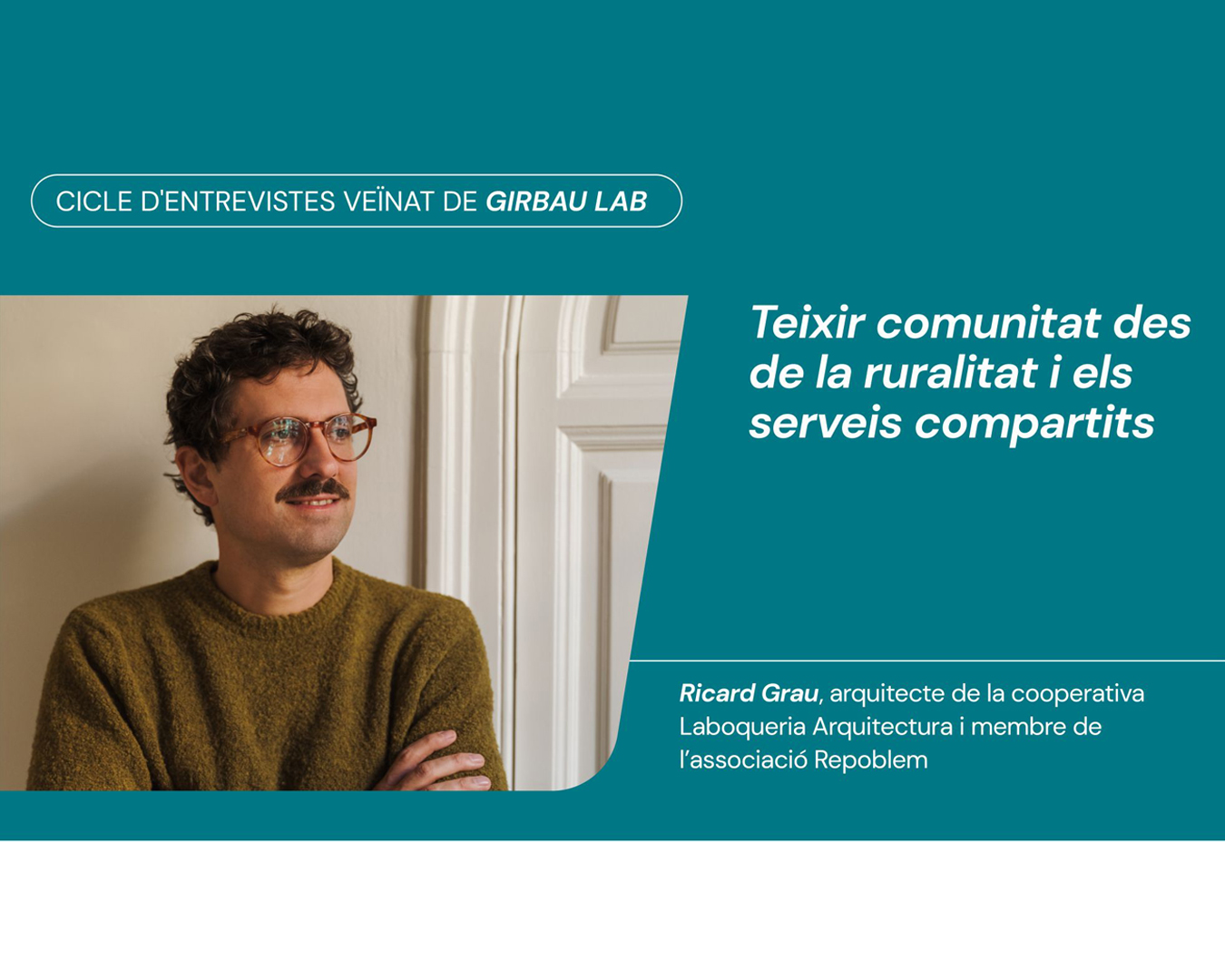
One of the last conversations in the series featured Ricard Grau, architect and partner at Laboqueria Arquitectura, as well as a member of the Repoblem association, an initiative linked to the revitalization of micro-villages and the new rurality in Catalonia.
Ricard Grau’s participation brings to the forefront an increasingly relevant issue in the contemporary territorial debate: how to rebuild community from small towns, recovering shared spaces, relationships of mutual support, and everyday infrastructures capable of sustaining life..
Rethinking the village from the perspective of care and interdependence
During the interview, Grau reflects on the paradigm shift many rural municipalities are experiencing after decades of depopulation, aging, and the centralization of services. In this context, she argues that micro-villages should not be understood solely in terms of scarcity or precariousness, but rather as territories with the capacity for social innovation and more resilient forms of coexistence.
Drawing from her experience living in Ametlla de Segarra, she explains how daily life in small villages is built on shared care, proximity, and interdependence among neighbors. “Living in a village is like spending a winter,” she remarks during the conversation, referring to the constant need for mutual support, both emotional and practical.
This perspective aligns perfectly with the research and practice that Laboqueria Arquitectura has been developing for years regarding rehabilitation in rural environments, the recovery of vernacular heritage, and the creation of new, more sustainable ways of living that are deeply rooted in the land.
Shared laundry as social infrastructure
One of the central themes of the Veïnat cycle is to understand the laundry not only as a domestic activity, but as a collective infrastructure capable of generating relationships, efficiency and community.
In this sense, Ricard Grau highlights the historical role of old washhouses as spaces for meeting and socializing in Catalan villages. These spaces, linked to water, conversation, and daily life, can now be reinterpreted from a new, contemporary perspective.
As he explains, many municipalities in the Vall del Corb are rehabilitating old washhouses and water-related spaces, not only to preserve their heritage but also to recover their collective value. This reflection is even more relevant in a context marked by the climate emergency and the need to manage water resources more consciously and collaboratively.
For Grau, community services linked to laundry, childcare, meeting spaces, or shared workshops can become key tools for retaining population, reducing isolation, and strengthening social cohesion in small villages.
Architecture, territory and new rurality
The conversation also connects with a broader transformation taking place in many rural areas of Catalonia: the arrival of new residents seeking slower, more sustainable lifestyles connected to the land.
At Laboqueria Arquitectura, this reality is addressed through architecture that values existing heritage, locally sourced materials, and ways of living adapted to the climatic and social context of each location.
Projects such as the rehabilitation of homes in Ametlla de Segarra or active participation in initiatives as Repoblem are part of this desire to demonstrate that contemporary rurality is not a nostalgic look back at the past, but a real opportunity to imagine more sustainable and community-oriented futures.
Ricard Grau’s participation in the Veïnat cycle reinforces this position and opens a necessary debate on how architecture can contribute to creating spaces for coexistence, shared services and new forms of neighborhood capable of responding to current social and environmental challenges.
You can check the complete interview within the Veïnat cycle of Girbau LAB.